Looking for Brick Slips for facade systems?
Visit our dedicated website.
Looking for Brick Slips for facade systems?
Visit our dedicated website.
Ah, the vital question for any building project – how many bricks do you need? Let’s start with the simple answer.
If you’re using modern metric size bricks and are building a single skin wall in a stretcher bond with a 10mm mortar joint, you will need 60 bricks per square metre (m²).
If you’re building a double skin wall, you’ll need 120 bricks per square metre (m²).
Sounds simple enough, but if you’re using a different size brick or brick bond, it can get a little more complex.
You’re in luck, if you want to skip the manual formulas below, use our brick calculator tool instead.
This handy tool allows you to enter either the width and height measurements (metres) or area size (m²) of your wall, choose your brick size, and select which brick bond you will be using.
Clicking ‘calculate’ will give you a breakdown of how many stretchers and headers you need based on using a standard 10mm mortar joint.
It covers single and double skin walls too, allowing for 1 header per brick for a single skin wall and 2 headers per brick for a double skin wall.
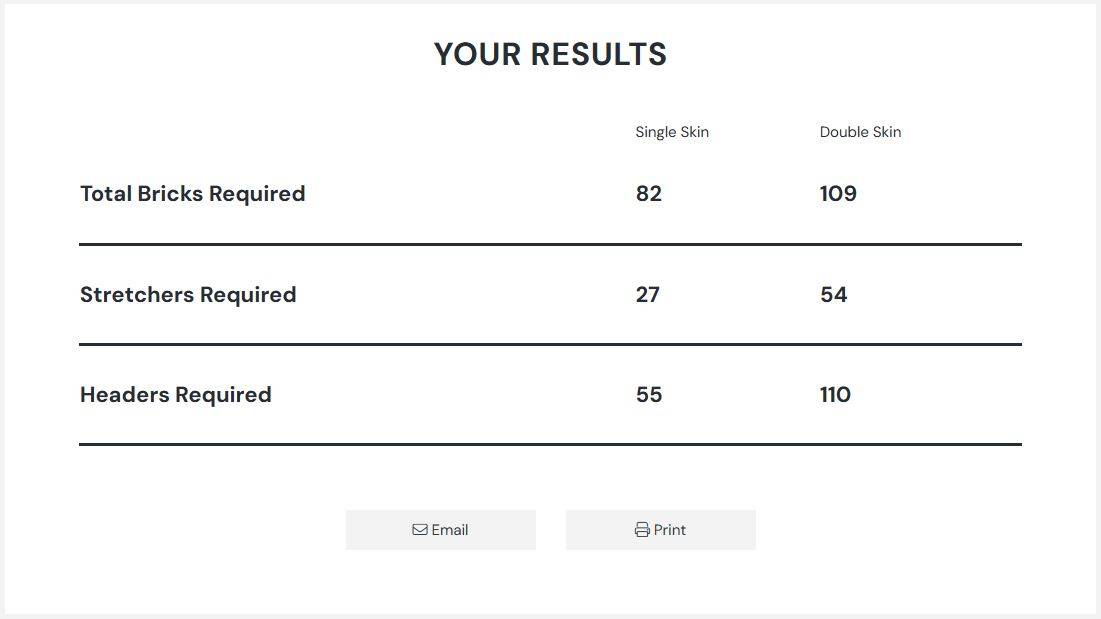
Example showing the results for one metre square (1m²) of imperial size 228 x 108 x 68mm bricks, laid in an English bond.
Knowing how many bricks you need for your project is a vital piece of information that drives your budget and the type of bricks you end up choosing.
Using the online calculator tool is a great starting point, but if you’d prefer to learn the manual formula, need to subtract windows and doors, or maybe just don’t fully trust an online tool and want to check it, we’ll walk you through how to do it.
Before you can work out your brick quantities, there’s a few measurements you need to check first.
Before we get to the bricks, you need to know the area size of your wall.
If you’re looking at architect drawings, chances are they’ll already have the area space on there.
If the wall space already exists, get the trusty measuring tape out and measure the width and height of your wall space, in metres (m).
Now, just multiply the two together to give you the area (m²).
For example:
Wall width: 3m
Wall height: 2.4m
Wall area: 3m x 2.4m = 7.2m²
This will often be dictated by your project type.
If you don’t know what a ‘skin’ is, think of it as a ‘layer’ of brickwork.
If you’re calculating for a new build, you’re most likely going to be using a single skin/layer of facing bricks with a cavity wall. The second skin/layer will be blockwork.
If you’re extending or renovating an older property, you might need to match up to the existing brickwork, which could be a single or double layer of bricks.
If you aren’t sure, the easiest thing to do is check with your architect.
To work out how many bricks you need, you need to know what size bricks you’re using.
You have three options: standard metric, hybrid or imperial size.
Standard metric size bricks in the UK are 215 x 102.5 x 65mm.
Anything differing from this is imperial size, or hybrid (has imperial height and metric length measurements).
Here’s a quick reference to help you:
Working on a new build?
Usually metric size
Extending or renovating a property built before the 1970’s?
Often imperial size, sometimes hybrid for extensions
Once you know, make a note of the size as you’ll need this for your calculation.
To work out how many bricks you need for your building project, you need to know how many bricks are in a square metre.
For a single skin wall using standard UK metric bricks with a 10mm mortar joint, you will need 60 bricks per square metre (1m²).
If you’re building a double skin wall, you simply double this figure.
But what if you have a different size brick?
Bricks that differ from metric are known as imperial size. They’re typically bigger than metric, so you need fewer bricks to cover the same wall area.
Here’s a reference table comparison of common imperial size bricks and their coverage areas, based on using a single skin with a 10mm mortar joint.
| Brick Size (length x width x height) |
Coverage per 1m² (with 10mm mortar joint) |
Brick Size Category |
| 215 x 102.5 x 65mm | 60 | Metric |
| 215 x 102.5 x 73mm | 54 | Hybrid |
| 228 x 108/110 x 68mm | 54 | Imperial |
| 230 x 108/110 x 68mm | 54 | Imperial |
| 228 x 108/110 x 73mm | 51 | Imperial |
| 230 x 108/110 x 73mm | 51 | Imperial |
| 228 x 108/110 x 75mm | 50 | Imperial |
| 230 x 108/110 x 75mm | 50 | Imperial |
| 228 x 108/110 x 80mm | 47 | Imperial |
| 230 x 108/110 x 80mm | 47 | Imperial |
All quantities assume bricks are laid in a stretcher bond.
The formula for calculating how many bricks you need per square metre (1m²) in a stretcher bond is:
1 ÷ [((brick length + horizontal mortar joint) ÷ 1000) x ((brick height + vertical mortar joint) ÷1000)]
Measurements need to be in millimetres (mm).
Now, if you’re looking at this thinking ‘It’s been a while since I’ve done maths like this…’
Don’t worry, we’re going to break it down together. You’ll be a pro in no time!
It’s all about the brackets here, so let’s use an imperial size brick as an example.
Say you want to use a brick that’s 228 x 108 x 68mm.
Labelling each dimension, this looks like:
Length: 228mm
Width/Depth: 108mm
Height: 68mm
You only need the length and height of the brick, which in this case is 228mm x 68mm.
Assuming you’re using a standard 10mm mortar joint, we’ll update the formula with these dimensions and break it down:
1 ÷ [((228mm + 10mm) ÷ 1000) x ((68mm + 10mm) ÷1000)]
1 ÷ [(238mm) ÷ 1000) x (78mm ÷1000)]
1 ÷ [0.238 x 0.078]
1 ÷ 0.018564
= 53.87
Rounded to the nearest whole (1) brick = 54 bricks
We’ve just worked out that for an imperial brick size of 228 x 68mm, you will need 54 bricks per square metre (m²).
Now you have the quantity of bricks you need for each square metre, it’s just a simple calculation to get the total for your wall space.
Take the area measurement of your wall and multiply it by the quantity of bricks per square metre (m²).
[wall area] x [number of bricks per square metre] = total brick quantity
In our example, the wall area is 7.2m² and we need 54 imperial (228 x 108 x 68mm) bricks per square metre (1m²).
7.2m² x 54 bricks = 388.8
Rounded up to the nearest whole brick (1) = 389 bricks.
It’s important to note that this total does not account for door and window openings and does not include wastage.
For peace of mind, you can always check your result against our brick calculator.
If you’ve used our calculator tool, you may have noticed it doesn’t currently account for door and window openings.
Don’t worry, it’s easy to do. It’s just a quick manual subtraction.
All you need are your door and window measurements to get started.
Before calculating brick quantities, you need to know the total area measurements (m²) of your wall and the door/window openings.
Wall Area
Measure the full width and height in metres (ignore the openings for now), then multiply them together.
Example full wall: 3m x 2.4m = 7.2m²
Door and Window Area
Measure all your doors and windows, then multiply the width and height.
Example external door opening: 1.981m x 0.864m = 1.72m² (rounded)
If you’re using a standard stretcher bond (i.e. no headers), you can work out how many bricks ‘fit’ inside your door and window openings and subtract them from the full wall total.
This will work for any brick bond, you’ll just need to have our brick calculator ready to hand.
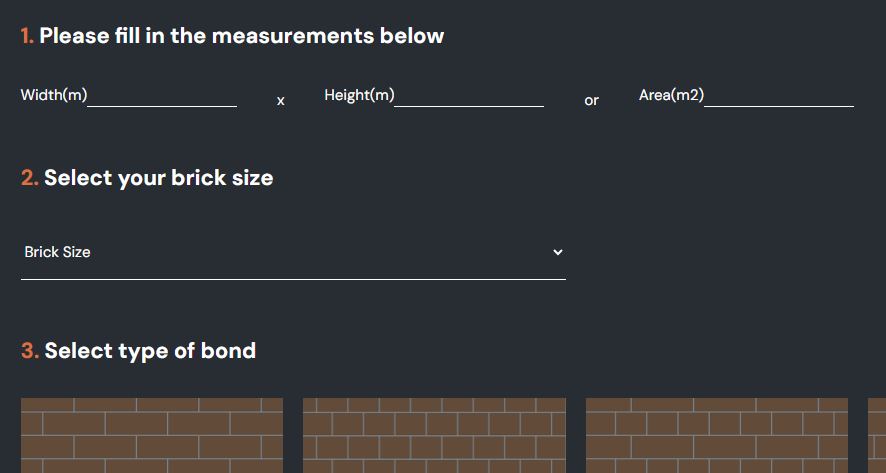
Most of the calculations we’ve explained so far only apply if you’re laying your bricks in a stretcher bond.
Stretcher bond is one of the most commonly used brick bonds for modern homes, and is the one you’ll see most often.
There are several other brick bonds which use headers, such as English and Flemish.
If you don’t know what header bricks are, imagine picking up a standard brick and turning it so the end is facing you. That’s known as the ‘header’ face.
In a solid wall, a header is just a brick turned sideways. In a cavity wall, you may be able to cut a brick in half to create two ‘snapped’ headers.
If you’re using a header bond with no stretcher faces it’s easy to calculate, but start alternating stretchers and headers within different courses (rows of bricks) and it becomes a bit more complicated.
To save you the headache with this one, we recommend using our online brick calculator. You can choose the bond you’ll be using and it’ll immediately give you the quantities of stretchers and headers you need.
If you need to subtract door and window openings, we’ve included a simple way to use the calculator to get your quantities above.
When ordering bricks, you must add 5-10% to the quantity to allow for wastage.
The last thing you need is to run out of bricks near the end of your build.
Wastage accounts for bricks cut on site and breakages.
The maths is simple for this, just take your total number of bricks and multiply it by 1.05 or 1.10 to get your 5% or 10% wastage allowance.
We’ll use the metric size of 60 bricks per metre square (1m²) as an example:
You don’t often need to measure in linear metres for brickwork, as it refers to the number of bricks you need in a singular straight line.
Unlike square metres, linear metre calculations change depending on how you lay the bricks. You typically use this measurement for capping a wall (bricks on end), or laying a single course/row (bricks laid flat).
Here are the quantities for standard UK metric bricks with a 10mm mortar joint:
Note: These figures are rounded to the nearest whole brick
As we’ve mentioned, there are two main scenarios for using linear metres and each has its own formula.
When capping a wall, bricks are stood on end (known as a soldier course). This means the height of the brick determines how many will fit in a metre.
Formula:
1000 ÷ (Brick Height + Mortar Joint)
Note: Measurements are in millimetres (mm).
Calculation Breakdown:
For standard metric bricks (65mm height) with a 10mm mortar joint.
Total: Rounded to the nearest whole (1) brick, you need 14 bricks per linear metre (m).
This formula is also used for vertical corners on brick slip cladding projects. If you’d like to learn about measuring for brick cladding, we have a guide on brick slip dimensions and how to measure for brick slips.
For a single line of bricks laid normally (lengthways), the length of the brick determines the quantity per metre.
Formula:
1000 ÷ (brick length + mortar joint)
Note: Measurements are in millimetres (mm).
Calculation Breakdown:
For standard metric bricks (215mm length) with a 10mm mortar joint.
Total: Rounded to the nearest whole (1) brick, you need 5 bricks per linear metre (m).
If you’re working on multiple areas or anything more complex than a single wall, using our brick wall calculator is always going to be faster than doing manual maths.
This especially applies with different brick bonds. They can be a bit of a headache and the calculator tool takes the complications away.
Why do the hard work when you don’t have to?
You just need to enter your wall dimensions (or square metre area if you already have it), choose your brick size and select your brick bond. You’ll instantly have your brick quantity calculations with headers and stretchers, and the option of single or double skin quantities.
Hopefully, this guide has helped ease any concerns (or headaches!) over calculating your brick quantities. If by any chance you’re considering our bricks for your project and need help with pricing or ordering, just drop us a line and our team will be in touch.