Looking for Brick Slips for facade systems?
Visit our dedicated website.
Looking for Brick Slips for facade systems?
Visit our dedicated website.
Brick bonding is the pattern in which bricks are laid in a wall.
Bricks can be laid to display their stretcher face (lengthways), header face (turned so the short end is displayed) or stood on end to create what’s known as a ‘soldier’ course.
There are many modern and historical brick bond patterns which all have varying levels of strength, labour costs and aesthetic appeal.
In this guide, we’ll explain the most common UK brick bonds, their structural properties and how to replicate historical bonds with modern cavity walls.
Before we get started, here’s a quick terminology reference:
These brick bonds are the most common seen in brickwork around the UK, for modern and historic buildings.
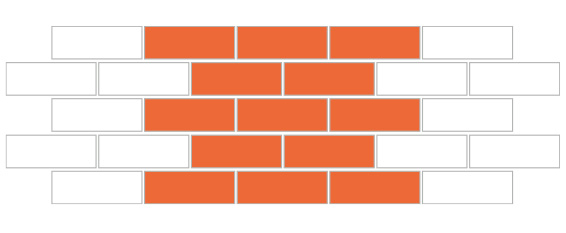
Stretcher bond (also known as running bond) is the most commonly used bond in modern day construction. Bricks are laid lengthways to display their stretcher face. Each course alternates by half a brick so the vertical mortar joints above and below each brick are central.
This bond is the modern standard for cavity walls as it uses the fewest bricks and is fast to build.
Want to see it in real life? Just glance at a few buildings when you’re out and about – it’s everywhere!
The Imperial Take: Stretcher bond is monotonous, so choosing a traditional brick with texture and/or natural colour variances will add character. Handmade bricks are a great choice if you want to create interest while limiting your bricklaying costs.
Pro Tip: To avoid large areas of brickwork looking monotonous when using extruded or pressed bricks, choose bricks with ‘multi’ or ‘blend’ in the name/description. They usually have an intentional colour variation.
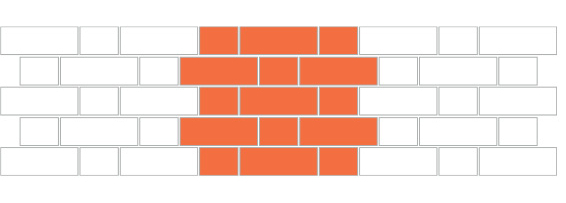
Flemish bond consists of alternating stretchers and headers in each course. Headers are placed centrally over the stretcher beneath, creating a visually attractive bond.
It’s a historical bond often seen in brickwork originating from the Victorian and Georgian eras. It’s also common to see vitrified or blue headers used to make the pattern stand out.
The Imperial Take: Extending or renovating older properties with this bond will usually require imperial size bricks. To replicate the blue-grey header colour, bricks can be tinted on the header face before laying.
Pro Tip: If you’re using this bond with a modern cavity wall, you must use snapped headers (i.e. bricks cut in half). Using a full size header brick will bridge the cavity which can lead to damp issues.
Real-World Example: See how Flemish bond looks on a finished build – check out the visitor centre on our Canterbury Cathedral project.
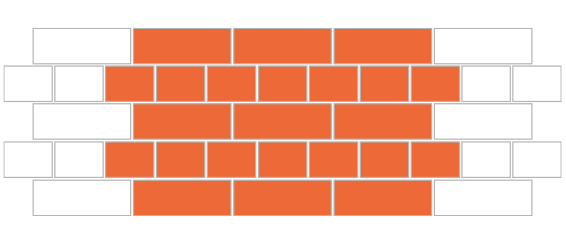
English bond alternates courses of stretchers and headers. One row is all stretchers, the next all headers and so forth, with headers positioned over the midpoint of the stretcher or vertical joint below.
This alternating pattern creates a very strong brick bond which was used extensively until the 17th century.
You’re most likely to see this bond in old industrial towns on warehouses and railway bridges, in conservation areas and in old church/estate boundary walls.
The Imperial Take: If you’re planning on extending or renovating an old property which has English bond, it may well have two layers of brickwork (i.e. double skin or one brick thick), which can elevate your brick and labour costs.
Pro Tip: Though it’s considered the strongest bond, English bond uses the most facing bricks per square metre, so make sure to account for the expense in both material and labour costs.
Real-World Example: See how English bond looks on a finished build – check out this Edwardian style new build project.
The garden wall bonds are variations of the English and Flemish bonds. Historically, they were developed because they require less headers, and therefore less materials and labour expense.
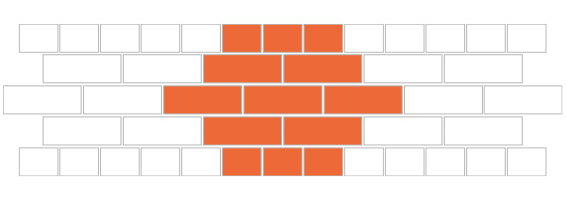
Derived from the English bond, the traditional English Garden Wall bond has 3 courses of stretchers between every 1 course of headers.
You’ll often find a variation of this bond (shown below) with 5 stretcher courses between the header courses, known as a ‘6th course.’

The garden wall bonds are primarily used for decorative effect. You’ll sometimes see the header course in a different colour to break up the continual stretcher bond and add interest to overall brickwork.
With fewer header courses, English Garden Wall bond is faster to lay than the standard English and carries a historical context, mostly seen in 18th-19th century brickwork.
The Imperial Take: Despite the name, it’s not just used for garden walls! You’ll often see this bond on Victorian terraces, especially in the North of England.
Pro Tip: Though similar, English Garden Wall bond uses fewer headers than the standard English bond, making it more economical but still providing good structural strength for residential builds.
Real-World Examples: See how English Garden Wall bond looks on a finished build – check out this elegant new manor house.
To see the 6th course version, take a look at the detail in this renovated Codsall home.
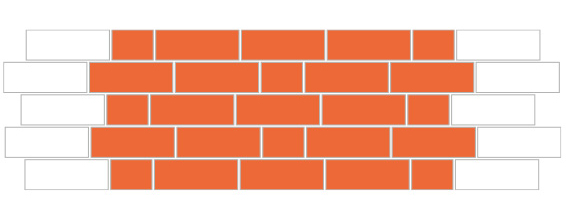
Flemish Garden Wall bond consists of a repeating pattern of three stretchers followed by one header in each course. The header brick is placed over the midpoint of the middle stretcher brick below.
This decorative bond is also known as a Sussex Bond, and is often seen in brickwork around Sussex and Hampshire – no prizes for guessing why the bond got its alternative name!
Though it can be seen in garden walls in the area, it was also used in 18th and 19th century domestic buildings such as farmhouses and cottages.
The Imperial Take: This bond is less ‘busy’ than the standard Flemish bond, making it ideal for long stretches of walling where you want to break up monotonous brickwork.
Pro Tip: Due to needing less headers than standard Flemish bond, it can allow you more budget to use expensive feature bricks such as glazed headers.
Decorative bonds add unique character and interest to what would otherwise be bland areas of brickwork.
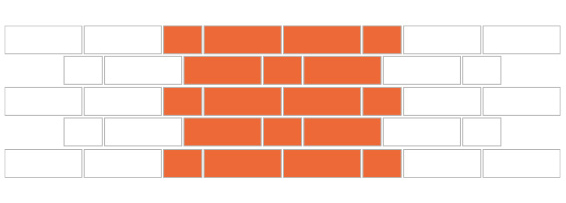
Monk bond is a repeating pattern of two stretchers followed by one header in each course. The header is placed over the vertical joint between the two stretchers beneath.
It’s similar to Flemish bond, but uses fewer headers due to the second stretcher between them, so is slightly less labour intensive.
Historically, it was mostly used in Northern Europe, but was succeeded by Flemish and English bonds, so isn’t commonly seen in the UK.
The Imperial Take: Monk bond creates a ‘zig-zag’ pattern which can provide a bespoke, decorative look for feature brickwork. Due to its rarity, it’s unlikely you’ll need to extend or renovate using this bond.
Pro Tip: If you like the look of Flemish bond, but not the associated brick costs, Monk bond could be a good alternative as it requires fewer header bricks per square metre.
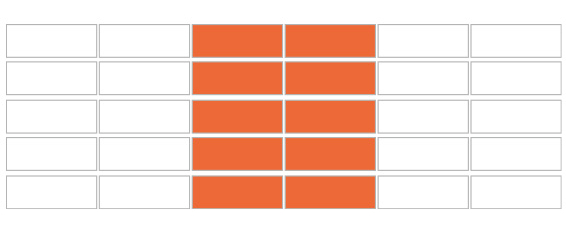
Stack bond is created by stacking bricks lengthways on top of each other with aligned vertical joints.
Its grid-style (or dare we say excel-sheet) look creates a modern aesthetic which suits minimalist architecture.
But, and this is a big but, the bond is extremely weak due to having no staggered joints. It lacks load bearing capabilities so if used, wire bed reinforcement must be installed in the horizontal mortar joints and the wall must be tied back to a structural support.
Pro Tip: Instead of battling the structural issues, consider using brick slips in a carrier system to create this look without compromising on structural integrity.
Real-World Example: See how Stack bond looks in the detailing of a finished build – check out this Edwardian extension.
These bonds are typically used for walling and adding decorative elements to stretcher bonds.
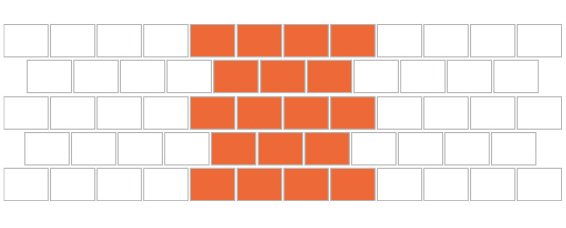
Header bond is created exactly as the name suggests – every course is made up of headers. Bricks are laid to display their header face, with each course alternating by half a brick so the vertical mortar joints above and below each brick are central.
It’s best used for curved walling due to the short distance between each mortar joint. It’s also used for corbelling and where radial (curved) brickwork is required, particularly above windows and doorways.
Pro Tip: Be mindful of your budget with this bond. You need double the number of bricks compared with stretcher bond for a one-brick-thick wall – it can get expensive fast!
Real-World Example: See how the Header bond is used in brick detailing – check out the infamous Eastenders set build.
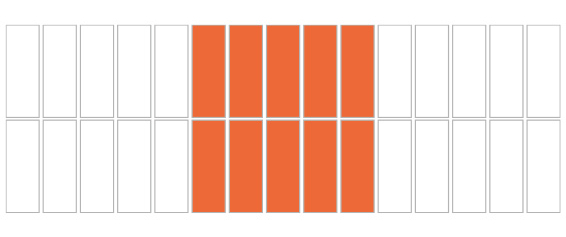
A soldier bond, or soldier course, is similar to the stack bond. Bricks are laid in a grid format, but stood on end as opposed to being laid lengthways.
This bond is almost always used for decorative purposes, or for capping walls.
When used as a soldier course, one course of bricks (usually of engineering quality or very low water absorption properties) is stood on end to cap a freestanding wall, creating visual interest whilst also providing protection from the elements to the bricks beneath.
In brickwork, you may see one or two courses of soldier bond used part way up a reinforced stretcher bond wall. This creates an interesting focal point within a modern aesthetic.
Pro Tip: If you’re using a soldier course to cap a wall, make sure the bricks are rated F2 for frost resistance and have a low water absorption percentage. Otherwise, you may end up needing to replace them sooner rather than later.
Real-World Example: See how the Soldier bond is used for detail coursing – check out this residential London extension.
English bond is typically considered to be the strongest brick bond due to the high density of headers tying the wall together in a one-brick-thick (double skin) wall.
Yes, but you must use snapped headers (bricks cut in half) so as not to breach the cavity gap and risk damp issues.
Stretcher bond is the most common brick bond seen in the UK. It’s used for most modern new builds due to requiring the fewest bricks per square metre (60) and being least labour intensive.
Brick bond patterns create strength and structure for facades by distributing the weight of the wall evenly. By staggering vertical joints, the wall becomes an interlocked unit rather than a series of independent columns (like stack bond) that may crack or collapse under heavy load.
Using appropriate brick bonds to correspond with your project is essential.
You can’t go extending with a stretcher bond when the original brickwork is Flemish – it looks awful and can be structurally problematic.
Not sure how many bricks you’ll need for your brick bond? Head over to our brick calculator tool to get the quantities for each bond pattern.
If you’re looking to match an existing property or want bricks with a bit more character, take a look at our traditional machine made and handmade bricks to execute these bonds while sustaining a heritage, traditional look.