Looking for Brick Slips for facade systems?
Visit our dedicated website.
Looking for Brick Slips for facade systems?
Visit our dedicated website.
London’s brickwork tells a story of local geology and architectural tradition.
Venture around England’s capital city and it’s hard to miss the abundance of yellow-hued buildings that adorn some of its most famous streets.
Whether you’re undertaking building work or are simply curious, all you need to know about London stock bricks, their characteristics and history is right here in this guide, along with tips on how to find bricks for a project.
So, let’s get started with the most obvious of all questions, shall we?
Stock bricks are traditional, hand-moulded clay bricks with a soft, sanded texture and natural creasing on the faces.
While the name “stock bricks” is a blanket term, they are most famously associated with London and South East England. Historically, they were produced by hand-throwing local clay into a wooden mould lined with sand. The resulting yellow bricks became the iconic London stock bricks we know today.
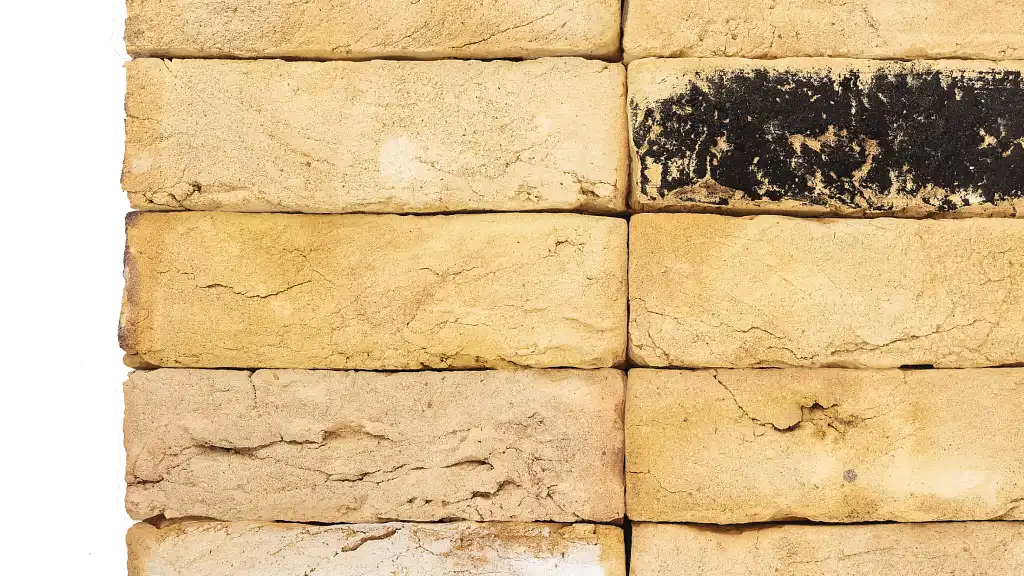
Modern stock bricks, however, are produced in a variety of ways. While some manufacturers still make them using the same age-old methods, machine-made options are also available. Machines replicate the clay-throwing process to produce the desirable creased texture, but due to the mechanical process, the creases tend to be finer and the brick itself more uniform in shape and appearance.
To understand how London bricks came to be, we need to take a step back in history. How they were originally made had a great impact on the colour, texture and overall look of the now-celebrated brickwork.
Centuries ago, before the transport infrastructures we take for granted today existed, bricks were manufactured in as close proximity to building sites as possible. Moving heavy materials across the country was costly and labour-intensive, so builders used whatever clay was available locally.
In London and the surrounding counties such as Surrey, Kent and Essex, quarried clay was chalky and contained a different mineral composition than the iron-heavy clays found around the rest of the country. This local clay produced yellow and buff tones when fired, which gave London bricks their distinctive colour.
Along with the variance in minerals, this clay was often mixed with coal and ash before being hand-thrown into wooden brick moulds lined with sand. Sand acts as a releasing agent and helps define the naturally formed creases on the brick face.
Back then, kilns were temporary and positioned as close to the clay quarries as possible to reduce unnecessary transport. Compared to modern kilns, their heat distribution was inefficient and firing required a lot of fuel.
Remember the coal and ash that was added to the clay? It acted as an internal fuel source, meaning less external fuel was needed to keep the kiln alight. After firing, the burned-away ash created a soft, porous texture and the coal remnants became the distinguishable “coal-spotting” seen on many old brick buildings around London.
During the Georgian and Victorian eras, the demand for housing, and therefore bricks used to build them, grew dramatically. Bricks were now being produced at an exponential rate, and many of the historic London and South East buildings originate from this time.
Due to the demand, brick manufacturers needed to find more efficient ways to produce bricks. It’s an obvious fact, but handmade bricks can only be made as fast as human hands allow. The first machine-made brick experiments began in the early 1800s, and by the mid-century, were being produced en masse.
As you can imagine, this revolutionised the brickmaking industry. Tens of thousands of bricks could now be produced daily. Over the forthcoming decades, the bulk of production switched to mechanical methods and has remained largely that way ever since.
Of course, handmade brick making methods weren’t eradicated completely. It simply became more cost efficient and practical to dedicate effort to machine production rather than traditional methods.
Today, traditional handmade bricks are still produced and supplied by select companies for sympathetic new building work and renovations. However, they do come with a higher price point and a lower availability than mass-produced machine-mades.
When thinking of London bricks, the vision that likely jumps to mind is the traditional yellow, maybe slightly ‘dirty’ looking, textured brick. But, did you know they aren’t the only types of London bricks? If not, let us enlighten you.
The first, and obvious, type of London bricks are traditional yellow stocks. Variations of these bricks have been used across London and parts of Surrey, Kent and Essex for centuries.
These classic facing bricks are handmade with a creased, sanded texture. Traditionally, they feature coal-spotting, natural shade variations and overburns.
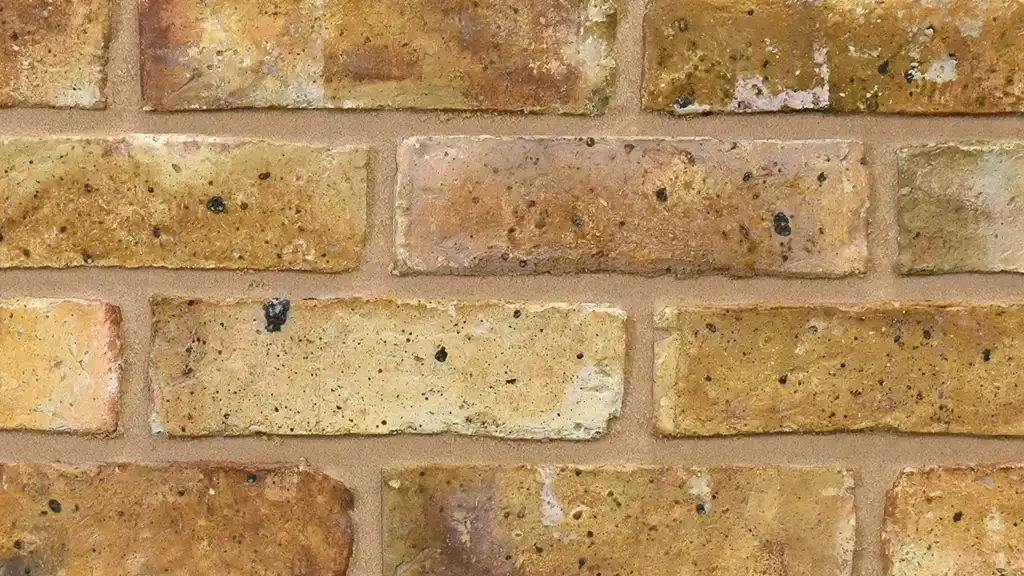
Above: New handmade bricks manufactured to replicate the old London yellow stocks – Original London Stock
Unless you’ve frequented the older streets of London, you may not know that a large number of Georgian and Victorian properties were built using red stock bricks, with yellows reserved for the front face of the building.
Clay found away from London and the South East contains high levels of iron-oxide, which produces a red colour when fired in the kiln.
Traditionally, they’re handmade with soft creasing on the face, though many modern sand-textured red bricks are now machine-made.
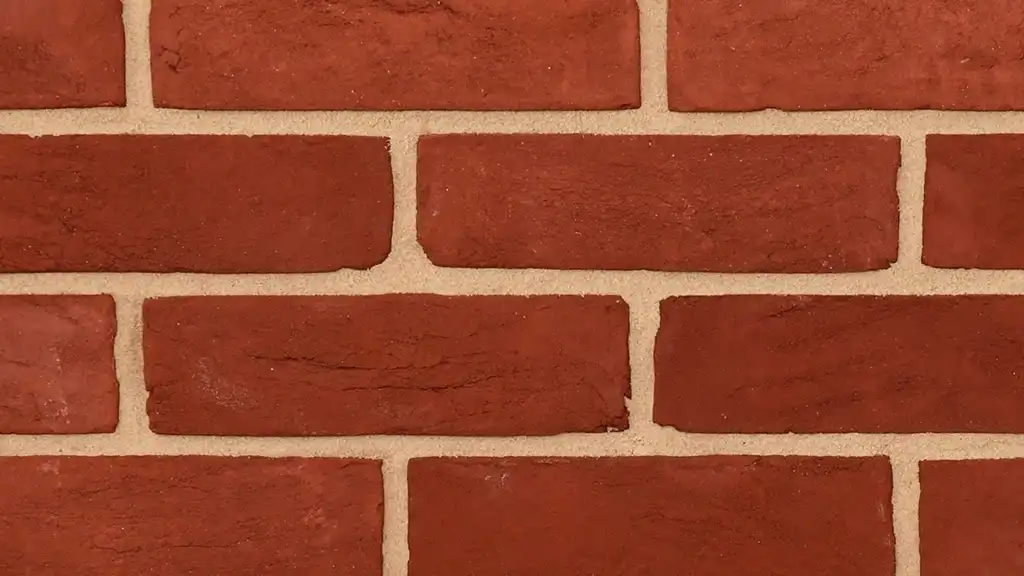
Above: New red handmade bricks with a softly creased texture – Red Rubber
As transport infrastructure improved during the Industrial Revolution, red clays from outside the local area became more accessible and affordable. Red clay, and subsequently red bricks, were available in higher volumes than yellow, so reserving yellow bricks for the front face of a building was a money-saving technique.
We mentioned that a lot of London bricks can look ‘dirty’ and aged. Though not strictly a type of brick, weathered and sooted variations of yellow and red stocks are worth a mention for brick matching purposes.
We all know London is a densely populated and busy city, and with it comes high levels of pollution. This, along with decades of exposure to the unpredictable British weather, darkens and ages bricks over time. They start off looking ‘clean’, but absorb soot and grime which clings to the brick faces, creating what is known as a ‘weathered’ or ‘aged’ look.
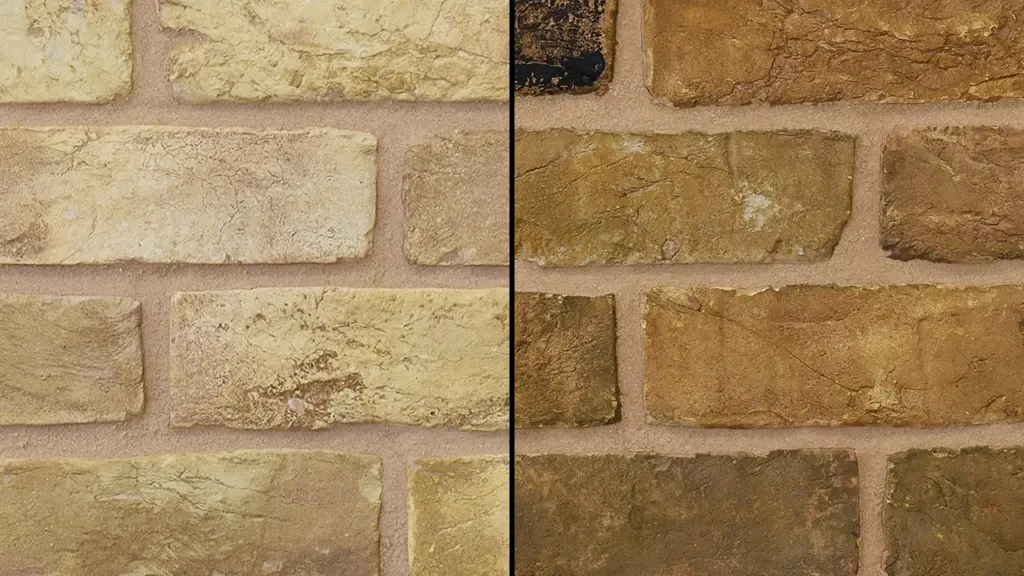
Above: Comparison of new yellow stock bricks against the same bricks which have been intentionally weathered/aged.
Though a bright and clean-looking brick may be perfectly acceptable for a new build property, London planning authorities often require these darkened bricks to be matched for extensions and renovation work.
Due to this, several manufacturers offer brick options that replicate the look of those older, sooted bricks.
Traditional handmade bricks generally have long lead times and can be expensive. With cost and availability being a key factor in any building project, most UK brick suppliers offer machine-made alternatives.
Wirecut and pressed bricks can both be made to mimic the creased, sanded texture of authentic handmades.
Wirecut alternatives are formed by forcing clay through a brick-shaped die and applying a creased, sand-faced texture with rollers before cutting.
Simulated handmade bricks are produced by mechanically ‘throwing’ prepared clay into a sand-lined metal brick mould with creased texture. The method is a fast, low-cost way of replicating the look of handmades.
Both options are best suited to new building work where matching older bricks isn’t a priority. Colours and dimensions tend to be more consistent, with tighter size tolerances than genuine handmades, though repeating texture patterns can be noticeable up close.
For modern London stock bricks, the standard size is the metric dimension of 215 x 102.5 x 65mm.
Old, traditional London stock bricks are usually imperial size. The most common size is 228 x 108 x 68mm, but you may come across slight deviations from these measurements.
The below table gives you an overview of the most commonly seen sizes.
| Size in Millimetres (mm) | Size Category |
| 215 x 102.5 x 65mm | Metric |
| 228 x 108 x 65mm | Imperial |
| 228 x 108 x 68mm | Imperial |
| 228 x 108 x 73mm | Imperial |
You’ll typically only need to source imperial size bricks when you’re matching up to old brickwork, as most new properties are built with metric bricks.
It’s also worth mentioning that if you’re planning to build using genuine handmade bricks, they will vary slightly in size – this is known as a size tolerance.
Some of your common queries about London yellow stock bricks, answered.
London bricks are yellow primarily because the clay found in London and the South East of England contains high levels of chalk and lime, and low levels of iron oxide. Iron-rich clays turn red when fired, whereas chalk and lime produce the yellow and buff colours so synonymous with the capital.
Clay minerals vary depending on where the clay was excavated, which is why each area of the UK has its own regional brick colours.
Yes, traditional yellow bricks are often more expensive than red. Yellow London stocks are highly sought after, and due to the lower availability of yellow clay compared to red, demand can outweigh supply.
If you’re planning to build or extend a property using yellow bricks, especially handmades, keep in mind that you’ll need to allocate a higher budget. Lead times can be longer too, so be prepared to order in advance.
Machine-made alternatives can be more cost-effective for new builds, though lead times may still be lengthy due to high demand for yellow stocks.
London bricks are truly iconic by nature; their colour and character are an integral part of the city’s building history. When it comes to sourcing bricks for building work however, it can be a difficult task to navigate.
If you’re planning a new build, you’ll generally have more options to choose from. Unless planning authorities state otherwise, new London properties can often be built using new, ‘clean’ yellow bricks. These can be easier to source than reclaims or traditional-style new bricks, as they’re produced in metric sizes and are more widely available.
As the city is so densely populated, many London projects are extensions of existing properties. Matching bricks for these can be tricky; you must take into consideration the original brick size, age and weathering, which can be difficult to do without professional help.
If you’d prefer to take the stress out of sourcing your bricks, we have a few options to help you:
We have award-winning experience in matching existing London bricks, so if you’d like some inspiration before getting in touch, take a look at some of our yellow extension and renovation projects.