Looking for Brick Slips for facade systems?
Visit our dedicated website.
Looking for Brick Slips for facade systems?
Visit our dedicated website.
If you’re here for the short answer, then yes, bricks are a sustainable building material. They can last over a century, require little to no maintenance, and can be fully recycled, making high-quality bricks exceptionally sustainable across their entire lifespan.
But what does brick sustainability actually mean?
If you start with an online search and aren’t familiar with some of the lingo, the topic can be difficult to navigate.
Though well intentioned, many online resources assume a high level of prior understanding, which, let’s face it, can feel overwhelming.
If you’re researching brick sustainability and thinking ‘I haven’t got a clue’, we’ll break it down into plain English to help you decide whether clay bricks are the right choice for your project.
Sustainability isn’t measured by one single element, it’s a combination of factors that span from initial manufacture, through the life of the building, to what happens when it eventually comes down.
We’ll cover four main brick sustainability factors:
| Sustainability Factor | What it Means in Plain English |
| Embodied Carbon | The carbon produced during brick manufacture, transport and construction of a building |
| Thermal Mass | How well bricks naturally absorb, hold and release heat |
| Durability & Longevity | How long bricks last before needing repair or replacement |
| End-of-Life & Recyclability | What happens to bricks when a building is demolished |
In each of the sections below, we’ll cover these in a way that actually makes sense and run through how it applies to your build, so you aren’t left scratching your head and repeatedly googling ‘What does [insert unknown sustainability factor here] mean?!’
This is a term that’s used a lot in the construction world, but its meaning to someone outside of the industry can seem a bit murky.
To keep it simple, embodied carbon is the greenhouse gas emissions produced from making, transporting and building with a product. In short, everything except the energy used to run the building once it’s built.
It’s usually broken down into:
Whole Life Carbon
You may also come across the term ‘whole life carbon.’ This includes all the aspects of embodied carbon, plus:
An easier way of thinking about it is all the carbon produced from the product, from manufacture, right through to demolition of a building (end of life).
For a building product, there are three ways carbon footprint can be measured:
For bricks in particular, manufacturers usually measure embodied carbon from ‘cradle to gate’, which is basically a fancy way of saying the process of extracting raw clay and manufacturing the bricks, to the point they’re ready to leave the factory.
Transport to your site is still part of the embodied carbon measure, but it’s often down to the specifier or customer to factor that in, as it can vary hugely depending on where the building site is located.
Generally, no. While manufacturing bricks uses energy, beyond quality building construction they need no maintenance or replacement, and produce no further carbon emissions during the lifetime of a building.
Yes, firing clay in a kiln uses large amounts of energy, and can create particularly high levels of carbon compared to some alternate building materials (such as timber). However, when we consider the end to end lifecycle (known as whole-life carbon), the impact is significantly reduced.
Bricks are designed to last at least several decades, if not hundreds of years. Compare this with other materials such as timber and steel, and the initial carbon cost of bricks balances out over time.
A lot of energy is used to make bricks, but their long lifespan offsets that upfront energy, making them a sustainable choice overall.
In its briefest form, brickmaking involves extracting clay from local quarries, moulding, and kiln firing. While energy-intensive, it’s an efficient process designed to create a product that lasts for centuries.
To create the right atmospheric conditions that ensure they can withstand potentially hundreds of years of weathering and exposure, bricks must be fired.
Kilns have been used for several centuries, but there’s no escaping that getting them to temperatures required for firing (typically over 900°C) consumes substantial amounts of energy and produces carbon emissions.
To combat this, the brick industry is continually adapting advanced kiln technologies designed to lower emissions. These include kiln optimisation, heat recovery systems and transitioning to alternative fuels.
Kilns and firing aside, manufacturers also commonly reabsorb waste materials back into the production cycle. Recycling water through closed-loop systems and reprocessing clay offcuts, for example, are standard practice.
Like many industries, sustainability is an ongoing journey, and a target the brick industry continues to strive for.
This is a fair question, which deserves an honest answer… Transporting building materials across countries incurs a carbon footprint.
Transportation is a necessary part of every manufacturing industry, whether it be by air, sea, rail or road. Without it, you wouldn’t have access to many products – everyday electronics, clothing and even popular car brands are mostly imported. Some are just further afield than others.
When it comes to bricks, there are several beneficial reasons for sourcing internationally. As a brick supplier working with international partners, some of ours are:
To mitigate the impact of transportation, many brick companies and suppliers will reduce their carbon impact elsewhere.
For ourselves, we ensure as much post-firing processing (such as brick blending) is done at source as possible, and locally recycle brick wastage. We also hold stock in multiple UK storage facilities to minimise unnecessary transport miles.
You may already know the UK is working towards a goal of net zero carbon emissions by 2050. The construction industry is a big part of this, so your architect is likely to factor it into the design and material specifications for your project.
For transparency, many manufacturers carry out Life Cycle Assessments (LCAs). From this, an independently verified Environmental Product Declaration (EPD) is produced, detailing the environmental footprint of a product.
If sustainability is a high priority for your project, you can request EPDs from manufacturers to compare product suitability.
Everyone wants an energy efficient building, not just for environmental benefits, but to also reduce the cost of energy bills long-term.
If you haven’t heard of the term ‘thermal mass’ before, it’s the measure of a material’s ability to absorb, store and release heat energy. Clay bricks have a high thermal mass, which helps to even out temperature fluctuations throughout the year.
In Winter, bricks gradually release stored heat as temperatures fall, helping a building stay warmer for longer. In Summer, they soak up heat energy from the sun during the day and release it slowly as outdoor temperatures drop in the evening, reducing the rate at which a building heats up.
One of the biggest benefits of using bricks for your self-build is their contribution to lowering your energy bills long term, especially when paired with good insulation and design. In turn, this also means a reduced carbon footprint across the building’s lifetime.
It’s no coincidence many UK buildings are built using brick. Thermal mass is one of the reasons it has remained the go-to building material for centuries.
When considering brick sustainability, durability and longevity are significant positive factors.
The longer a building remains maintenance-free, the lower its environmental impact. If a building’s structure is optimal, bricks rarely, if ever, need maintaining or replacing.
In comparison, alternative options may need intervention long term, such as repainting or patching render and replacing panels in cladding systems.
Clay bricks are considered to have a high carbon emission cost upfront, but a building that stands for a century or longer justifies that initial cost many times over.
High quality clay bricks can last in excess of 100 years, and some well-constructed brick buildings have stood for several centuries with little to no maintenance work.
You only need to think about how many historic buildings have survived multiple centuries to understand how long bricks can last.
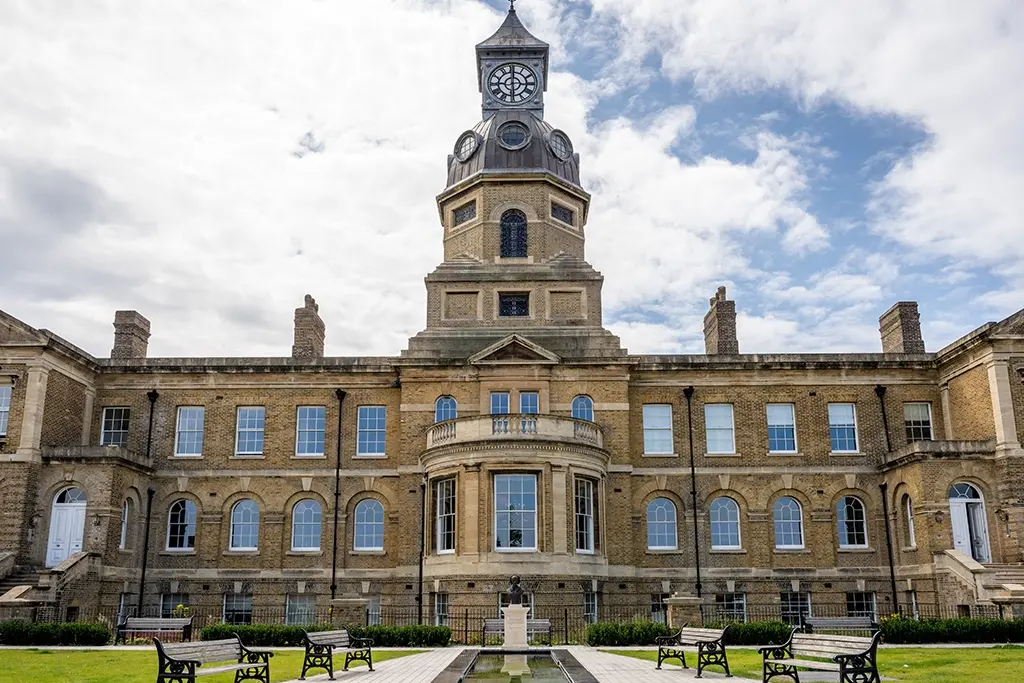
One notable example is the historic Cambridge Military Hospital site, first built in 1879. Despite being abandoned and left unused for years, much of the original brickwork survived and was incorporated into a modern residential conversion.
If you want your property to last as long as possible with practically no maintenance or intervention, build with bricks.
As long as you choose bricks classified as F2 for frost resistance (which you can check on a product’s technical data sheet), beyond initial construction there’s rarely any need to spend more of your hard-earned cash on bricks, saving you funds in the long run.
Bricks are also made from a natural resource and once manufactured, do not emit significant levels of Volatile Organic Compounds (VOCs) like other common building materials, which may have an impact on long-term health.
Choosing bricks over alternative materials can be a bonus for the environment, your health, and your pocket.
When it comes to end-of-life and recyclability, clay bricks are a highly sustainable choice.
It’s unlikely you’ll be building with the intention to demolish later on, but it’s worth knowing that at the end of a building’s life, bricks can be reused for both new building work and aggregates.
Yes, reclaimed bricks are a more sustainable choice when it comes to building a new property, especially if lowering embodied carbon is your aim. However, they can be difficult to source in the size and volume required, so alternatives such as new, old style bricks are often used instead.
Bricks reclaimed from demolition are a highly sought-after product, for both their aesthetic appeal and sustainability impact. They’ve already been manufactured and served their purpose in a previous building. Giving them a second life as part of a new building carries minimal carbon cost beyond cleaning and transport, plus they may even be reused again in the future!
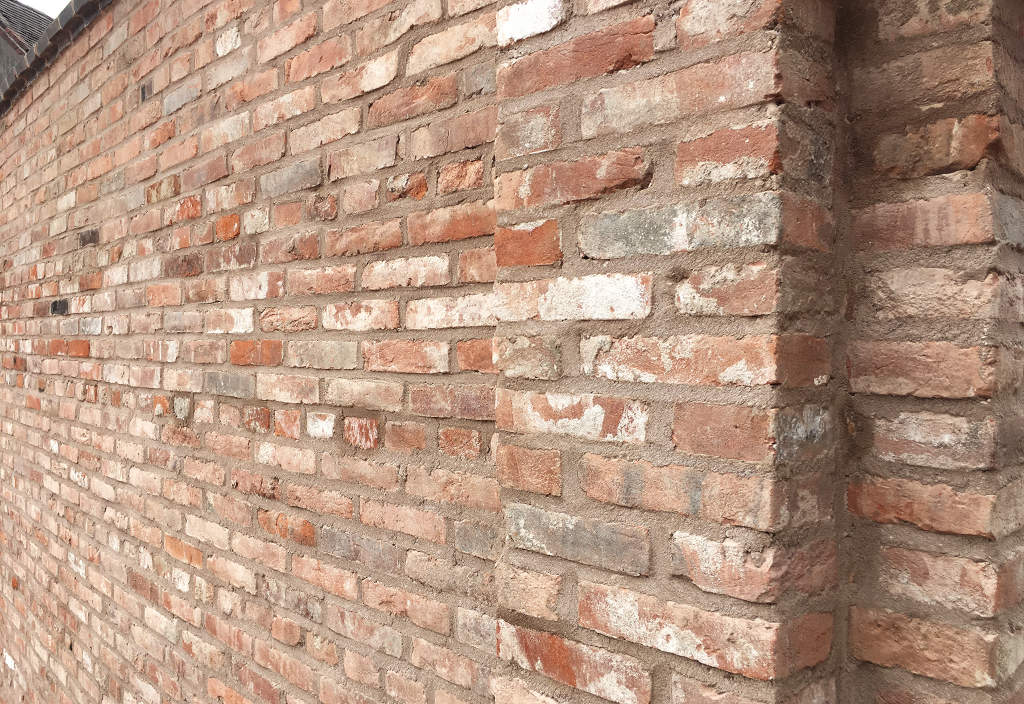
Image shows reclaimed bricks repurposed for walling in a new build home.
As with all good things, there’s a caveat. Reclaimed bricks are increasingly hard to source, especially in the quantities and size needed for new buildings. They also carry an increased wastage percentage per pallet compared to new bricks, so if reducing carbon is your aim, wastage disposal needs consideration.
The solution to this is to consider using new, old style bricks instead of reclaims. New bricks made to look old do come with an upfront carbon cost, but their durability means that cost is spread over a very long lifespan, making them a great long-term choice.
When a building is demolished, contractors will go in to sort, clean and pack salvageable bricks for resale. Clay bricks are one of the few building materials that can be used time and time again.
For any bricks that don’t make the cut, they’re often processed into aggregate material and reused elsewhere. This process is the perfect example of a circular economy.
At our processing facility in Shropshire, we do just that. Ageing and weathering bricks, along with brick slip cutting, produces some brick waste. This waste mostly consists of bricks that didn’t pass the aesthetic QC, and inner-brick waste from slips. It’s taken by tractor load, crushed, and graded into various sized aggregates for reuse locally. To name a few uses, it can end up as landscaping aggregate, foundation fill or a subbase for roads and pathways. If you ever visit our HQ, keep an eye out, you may just see a collection in action!
Using bricks for your build practically guarantees a level of recyclability in the future. With the high demand for reclaimed bricks, you can build with the knowledge you’re contributing to a circular economy.
Plus, any brick wastage on site such as offcuts or the odd broken brick can be crushed and reused rather than going to landfill, which reduces waste and contributes to your project’s overall sustainability.
When brick sustainability is high on your list of priorities for your self-build project, knowing what manufacturing documentation to check makes everything that little bit easier.
As a brick supplier who works closely with long-term manufacturing partners, here are the credentials that are worth checking:
Any manufacturer or supplier should be able to provide evidence of a product’s sustainability credentials. For us personally, we ensure our manufacturing partners adhere to the recognised standards stipulated in The Imperial Standard.
High quality clay bricks are an extremely sustainable building material. They’re produced from natural clay resources, manufactured to withstand harsh climates, and have a lifespan of 100+ years. At end-of-life, they can be reused for new building work and any wastage can be crushed and recycled for use as aggregate.
As with all products, bricks aren’t perfect. Their upfront carbon emission cost from manufacture is higher than some alternatives, but their longevity and near-zero maintenance requirements mean their whole-life carbon impact is one of the lowest of any traditional building material.
Sustainability typically falls into four categories:
Bricks perform well in all four areas, particularly when it comes to thermal mass, durability and recyclability.
If you’re planning to use bricks for your project and sustainability is on your mind, here’s a quick recap of the things you can do or check for:
All of our bricks and manufacturing partners meet the criteria set out in The Imperial Standard, so if you’re interested in browsing our traditional brick ranges, you can be confident they’re ethically sourced and meet modern sustainability requirements.